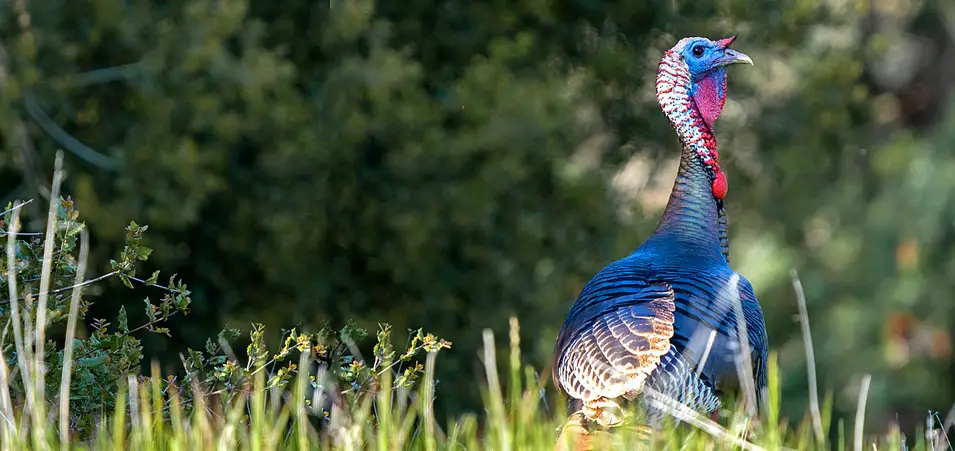
Everyone wants to hunt turkeys on endless thousands of acres of unpressured land, but the reality is often far from that. Some people only have access to small properties, sometimes just a few acres. Can you really hunt turkeys on small parcels and find success? The short answer is of course. But you cannot hunt those small properties the same way that you hunt large properties, you need specific strategies and tactics for small land.
There are two main approachs that I am going to cover in this article for hunting gobblers on small properties. The first is your traditional scout and hunt, just like you might do on public land, but with limited space. The second assumes you can enhance the property to draw more turkeys and make the most of a tiny parcel. If you are looking for information on how to start hunting turkeys, check out this article I wrote: How To Hunt Spring Turkeys – A Practical Beginners Guide.
How Small Can A Property Be To Hunt Turkeys?
You can hunt turkeys on properties as small as one acre. It’s not easy, but you can do it. And since you don’t have to track a turkey after a good hit, you can shoot and recover it in a very small area. I consider a property small if it is between 1-40 acres. At that size you are unable to run and gun much, you likely have limited locations you can setup, and your ability to move and use terrain to your advantage is going to be limited. So, most of these tips are going to be aimed at properties in that size range. Want more info on this subject on the go? Download my podcast episode: How to Hunt Turkey’s on Small Properties.
First Thing – Are There Turkeys?
Whether you have 1 acre to hunt or 1,000 acres, there is a common truth. There must be turkeys there if you are going to successfully hunt them. The advantage of larger properties is there are higher odds that they will hold turkeys, but you still need to find them. Small properties have their own kind of advantage and that is you can more easily scout a small area and look for turkey sign.
You need to scout. Not just to find out if turkeys are on the property you plan to hunt but to figure out how they are using that property and when. The four best ways to do this are by walking around stealthily before the season and looking for tracks, droppings, scratches, features, etc. The second is with binoculars from a distance and the third is by using trail cameras. Number four might cost you some sleep, but if you get out there before dawn and listen for gobbling you can learn ALOT.
If you can find the birds you can hunt them. Things are not necessarily over if you do not have turkeys actively on your property. The beauty of turkey hunting is you can call birds in from other places. But that is harder to do and it is hard to scout those other places if you do not have permission to hunt there. Your ears and binoculars are going to be the tools available to you. For more, check my podcast episode: How To Find A Great Turkey Hunting Spot.
Seasonal Turkey Occupancy
People have a notion that turkeys in the winter means turkeys in the spring, or turkeys in the fall means the birds will be there when the weather warms back up. In truth, today’s turkey behavior may give no useful indication about where they will be a couple months from now. The reason is that turkeys move, they cover ground, they look for what they need right now.
Turkey’s need different habitat at different times of the year. However, spring turkey locations this spring may be telling of where the birds will be next spring. If a property has good spring habitat, then it will likely be a place that is pleasing to turkeys every spring. Nothing is guaranteed but turkeys do tend to frequent old stomping grounds. The same is true for other seasons, this year’s fall hotspot will likely be hot next fall too, but they may be nowhere near that area come spring.
So while I am scouting for turkey’s year-round, whenever I am in the woods, I know where I find them today may not help me find them in the spring. But the time I invest scouting around the spring season can pay dividends for future spring hunting seasons.
But I never Did It Like That Before…
If you do not have many acres to hunt, you may not be able to hunt the way you would prefer to. If you do not have big trees you may not be able to hunt sitting up against a tree like many turkey hunters. You will have to explore other ways to hunt that area. Bushes, blinds, and ground cover may need utilized. Terrain features, self-standing turkey chairs, or even pop-up blinds might be what you need.
If you cannot hunt the part of the property that is most likely to hold turkeys because it is not wooded, you do not have the luxury of just going somewhere else, you have to improvise. Keep in mind, the goal is to take turkey’s not to hunt your traditional way, or the way people do it on TV. Think outside the box, look for ways to use the land, the shadows, the elevation changes, anything you can to get a chance at a gobbler.
Learn Your Limits & How To Cheat Them
Property boarders are the arch nemesis of small parcel turkey hunters. Beautiful land divided up by invisible lines that dictate where you can and cannot go. People often setup so that for a turkey to come into shotgun range, it will have to cross onto the land they are allowed to hunt. They setup markers, mental notes, etc, and this is good, you MUST know the boundaries. But there are ways to cheat.
Sometimes being 60 yards back from the property line is too far back to finish the deal. Keep in mind you can move right up to the property line to call, you even go side to side along the border and then retreat back deeper into the property if you can get a bird’s interest. You can also call and then move along the border quietly and setup with your shotgun aiming parallel to the property line, ready to take a shot from the side as soon as a big tom walks on your property. Think in three dimensions and with some fluidity and you can expand your options. A good hunting map app like OnX Hunt or HuntWise can be very handy for knowing exactly where you can and cannot hunt, here is a written review where I compared both.
The Strategic Sit
The most commonly used turkey hunting method on little properties is the strategic sit. This involves scouting and working to learn the best place for turkeys to be on your property, the best place you can hide to hunt that place, and then sitting in ambush. You will call, but not likely move much or at all. This can feel more like deer hunting than turkey hunting, but it gets the job done. And truth be told, many turkey hunters prefer to hunt like this.
The strategic sit hinges on strategy. Picking the best spot and hunting it the best way possible. Your options are limited so long stealthy hunts are going to give you the best odds. But to power through those long hunts, you must have the concrete facts that only scouting can produce; that there are turkeys in the area. Whether you hear them or not. If the results of your scouting are poor then your motivation will be poor too. Good scouting produces good strategy, and strong drive to stick to the plan because you know you have a real chance to succeed. People often ask about decoy use. There is a time for decoys but often I think they can be a hindrance. For more, here is an article I did: How To Hunt Turkeys Without Decoys & Be Even More Successful.
It Almost Feels Like Cheating
Some people lament the use of a ground blind or pop-up blind for turkey hunting. I used to be one of them. But I became acquainted with the tool while hunting a very small property. I have since come to adore ground blinds for this kind of hunting because of the many advantages. Yes, I would rather be covering ground, going toe to toe to gobblers, using the terrain and everything I can to bag one. But if I am hunting a small property, the ground blind provides unparalleled concealment, comfort, and a different but fun way to hunt.
I like to use mesh on the windows of my ground blinds which offers even more concealment. I have found myself surrounded by turkeys when in a ground blind, birds within a few feet of me. The rush, the thrill, the learning, are very intense. I never get that close when sitting against a tree, at least not for long. But I’ve sat in the middle of feeding and dusting hens for half an hour, not moving a muscle, trying not to breath at all, not even wanted to blink so I do not spook them, while waiting for gobblers to appear.
I think the ground blind is a great tool, and it provides fun and excitement of a different kind than more active styles of turkey hunting. The beauty is we can have it all. You can travel to public land and cover miles, and you can sit in a blind on private land and not move a muscle while the birds come to you. We don’t have to pick; we can do both. For the last few seasons, I’ve been using a very large Barronett Ground Blind. This works good because I can easily fit two large adults with gear in it and it is very sturdy, the most durable blind I’ve yet to use. Blinds are always smaller than they sound, take the number of adults a blind is rated to fit and subtract one to get a more realistic estimate.
The Wandering Gobbler
Sometimes you will hear gobblers at first light near or on your small property. Other times you will hear nothing at dawn but the birds may make their way to your location after a few hours. Sometimes there are no regular birds on or near your property that you can call in. But there is always hope. There is the wandering gobbler.
Gobblers pretty much never stop moving during the morning, they are always on the go, looking for hens, food, and more hens, sometimes they will wander outside of their regular patterns, even going miles in a day. These birds can come within ear shot of you, hear your occasional calling and come in for a visit. They may or may not gobble. They can come out of nowhere and are unpredictable. But they provide hope for all turkey hunters who cannot move to another spot. They also give a reason to continue calling from time to time, even when you do not hear a response. For more, here is a podcast episode I did on How To Hunt Silent Turkeys.
The Circuit
Just because you have a small property does not mean you cannot move. If you have at least a few acres you can establish some kind of circuit that you can walk from place to place or from property corner to corner and call for turkeys if there is no early gobbling or activity. This is in some ways similar to running and gunning but your goal is to reach out beyond the borders of your property as far as you can to draw birds in closer.
You will want to find or prepare travel routes that should let you move around the property quietly and behind cover. You will also want to identify good cover at each point you intend to stop, and call from incase a gobbler responds and begins to come in. The good news is that you can learn your land exceptionally well when you do not have much of it. You can learn every tree, every hill, every bush. You can get to a point where you walk your circle on autopilot with great stealth.
Does Moving Help?
Does moving around on a property really improve your odds of success? It depends. On 3 acres, probably not. moving around is likely a liability as you may spoke the birds you are hoping to attract. If you have 40 acres however, you may have several distinct spots you can stop and hunt and be able to locate gobblers that may have been out of call range from your home base spot. You may have birds on the property that you can move closer to or try to get in front of. Your options increase a lot when you have a few more acres.
I have walked a circle around a 12-acre property, calling at maybe 4 or 5 distinct locations only to sit down at my last point on the circuit and see a turkey within minutes that was excited by what it thought was a hen, making its way across the property. You do not want to move very fast when doing this, try to stay at turkey speed. You want to play the part; this kind of movement can do multiple things to get birds engaged. Check out this video I did for even more strategies to hunt small properties.
Ammo And Chokes For Small Properties
Typically, on a small property, you are not going to be able to take long range shots. You also want to keep the turkey and your shotgun pellets on the property you are permitted to hunt. So, you tend to take shorter shots, or as I call them, normal shots. Usually, you are shooting at turkeys at an average of 30 yards or so. To do this, I am going to prefer smaller pellets and milder turkey chokes. Maybe that is #6 lead or #9 TSS with your standard XX Full choke. I normally use Winchester Long Beard XR or BOSS Tom TSS, I did these full reviews on each.
You do not need ultra-tight chokes because the pattern can be too tight at close range, and you can miss. I like smaller pellets because you then have more of them and better odds of a quick humane finish. ALWAYS pattern your shotgun in advance and choose a load and choke that will let you effectively hunt the ranges your property affords you. The gold standard is to get 100+ pellets in a 10″ circle at the range you plan to hunt. If you can do that, your ammo and choke are perfect. And keep in mind, within 30 yards, nothing can kill a turkey any deader than cheap #7.5 target loads. You only need “turkey ammunition” for longer ranges.
Improving Properties
If you own the property or have permission to improve the habitat, there is a lot you can do for minimal cost to make a small property more desirable to a turkey. You can both draw more turkeys and hold more birds throughout the season. It may take some work though.
In a given day, turkeys are going to want roosting trees, cover, open areas, dusting areas, strut zones, food, and water. The smaller the property, the fewer of these things you will be able to provide. But the more of them you do provide, the more draw your land can have for gobblers.
How To Improve Your Turkey Habitat
Roosting trees are either there or not. There is no short-term fix here. All you can do is seek to draw them to your large trees with the hopes of getting them to roost close by if possible. Cover and open areas can be facilitated. Turkeys like brush to hide and escape and open areas to feed and be able to see predators from afar. If you have lots of thick brush, then clearing some of it can help improve the draw.
If you have lots of woods, then taking down a half-acre of canopy can enable you to create a small patch of grass on one side with regeneration and cover on the other. Dusting areas and strut zones are harder to fabricate but they are often found in flat dry open areas with low vegetation. Toms want to be seen strutting, and good dust is often found in areas with bare sunbaked dirt. Create those and you give turkey’s more of what they like.
Water provides some benefit but only if there are no other easily accessed water sources within about a half mile. A stream, spring, creek, or even just a few puddles is all turkeys need, normally they only take one short drink per day, depending on their diet. Food on the other hand is maybe the single biggest thing you can do to attract turkeys.
Food Plots & Clover For Turkeys
There are many things you can plant as food for turkeys that will drawn them to your property, but there is only one that I recommend as a starting point for new hunters and that is white clover. Clover is easy to plant, and you do not need any heavy equipment. All you need to do is create bare dirt. This can be done with a lot of determination and a weed eater with a big pack of heavy line. It can also be done chemically with Roundup and similar products, a few applications in the spring and summer can create a perfect place to plant for the fall.
You do not need to plant acres and acres of clover, in fact just a 1/4 of an acre can make a big difference. For the last few years I’ve been using Imperial Whitetail Clover, which I think may be the best seed out there, and for a small food plot it can be very inexpensive. Even just 1/10 of an acre can help. For a micro plot like that, you’ll need $10 of clover seed and $20 of pelletized lime.
The best part about clover is it grows back every year and provides high protein forage during the spring turkey season. It also works great as a grass that attracts bugs for turkeys to eat, and it is fairly low in the spring, giving the birds a nice open area. So you get multiple benefits. Deer like it a lot as well. For more, listen to my podcast episode: Turkey Hunting Food Plot Basics.
Conclusion & Recommendations
A small property can be a great place to hunt turkey’s, especially if you are able to add some food and improve the habitat. Even a micro property can be a place you can take turkeys. The most important thing you can do is keep your mind open, think outside the box, and think beyond the season. You need to do everything possible to stack the deck in your favor. And that means scouting, strategy, and habitat improvements.
I have taken lots of turkeys on smaller pieces of land and I have come to really enjoy this style of turkey hunting. In fact, I now enjoy it just as much as I do hunting big public land. Each is fun and has its own pros and cons. I hope this article equips you to make the most of the opportunities you have available and have the most possible fun hunting turkeys!
Be sure to listen to The New Hunters Guide Podcast and check us out on YouTube.
Till next time. God bless you, and go get em in the woods!
George Konetes Ph.D. – Founder and Host of the New Hunters Guide.
The New Hunters Guide is simply what George wishes he would have had when learning how to hunt; a single place to get practical hands on knowledge about different kinds of hunting, gear, strategy, and tips that can improve your comfort and fun factor in the woods.